


An interactive scientific exhibition
Can You Stop Time?
Play of Time is a timing trainer built around one deceptively simple task: press, wait, and stop at exactly three seconds. The point is not the timer itself. The point is what the timer reveals about perception, rhythm, self-control, and the body’s response to a very small interval.
What follows explains why it works — then puts the timer in your hands. Play now →
Premise
Everything we do happens in time
Video explanation of the Play of Time idea
Whatever we do, we do it in time — the sharper that sense, the more manageable everything built on it becomes. Play of Time strips the idea down to one task: no multitasking, no distractions, just your own mental and motor speed against a fixed target. One repeated attempt teaches more than a paragraph of explanation — which is why this is a game, not a lecture.
Training
What it trains — and where it carries over
- Perception of very short time intervals, down to milliseconds.
- Synchronization between perception and movement.
- Voluntary control over functional state.
- Attention, internal rhythm, and emotional regulation.
- Self-control in conditions that are simple but not easy.
It looks like nothing more than press-and-stop. In practice it surfaces patterns in attention, anticipation, and motor timing you can't see from the inside — useful in sports where timing shapes the result, in meditation and body awareness, and as a quick read on which kind of day you're having before it costs you something.
Control
The main lever is excitation and inhibition

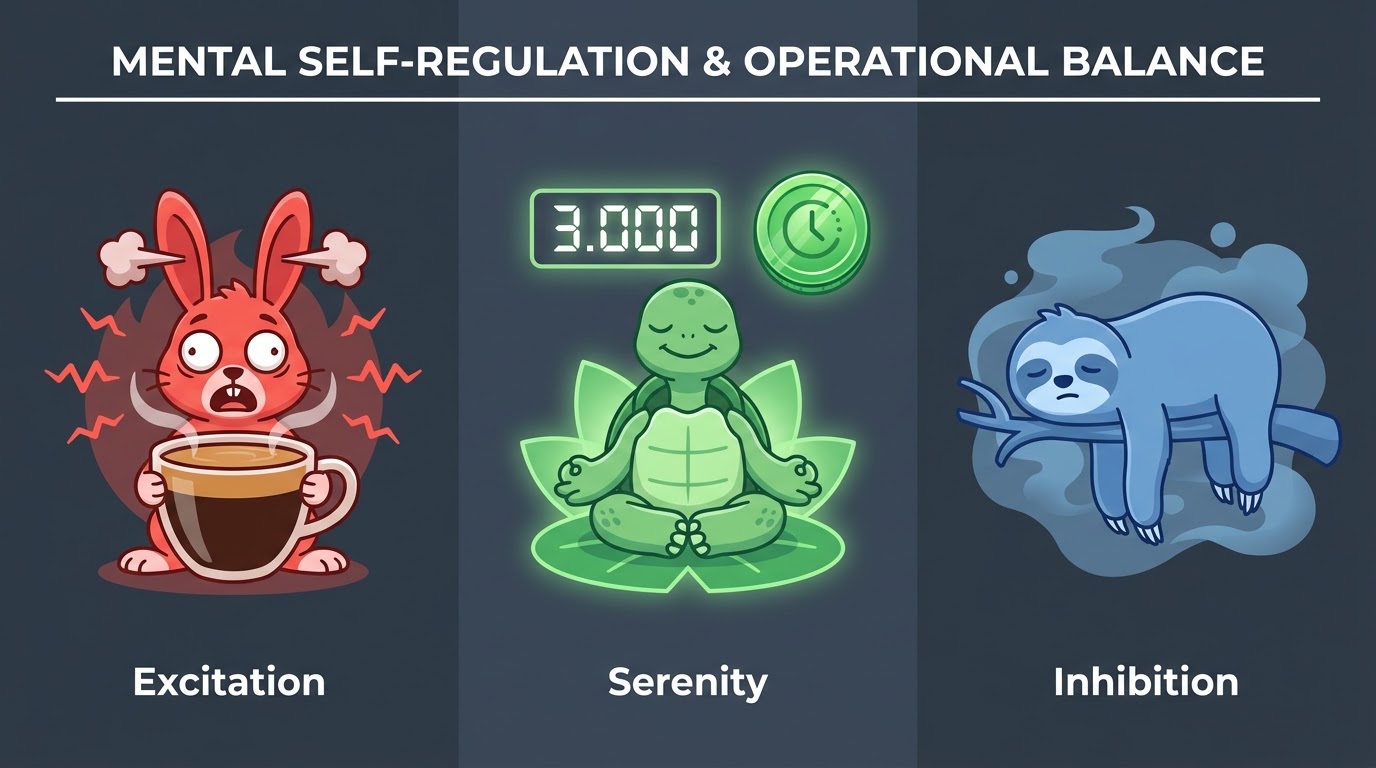
Too much excitation and the response comes early — an overcorrection that races ahead of the target. Too much inhibition and it comes late — caution that overshoots the moment. Play of Time calls the narrow zone between them serenity: not calm as a mood, but calm as a working state you can return to on command.
Serenity Coins measure that state directly. They aren't a reward for one lucky press — they accumulate only when your control is repeatable, attempt after attempt, which is what makes them a genuine record of self-regulation rather than a trophy for chance.
What the numbers show
Luck is not mystical here
Imagine 2,001 possible outcomes on the stopwatch — only one of them lands exactly on 3.000. Real people aren't random number generators, and that gap between chance and actual performance is what the game turns into the Luck Coefficient: a running measure of how far your results diverge from pure randomness.
Every player also drifts in a personal way — some run early, some run late, and the tendency shifts with mood, fatigue, and rest. The quest system reads that timing profile continuously and adapts its targets to it, so progress reflects your own drift correcting itself, not a fixed external standard.
Research
Inspired by the work of S. Gellerstein

The scientific grounding comes from S. Gellerstein's research into how people perceive and act within very short intervals — work rooted in real performance under time pressure, not laboratory abstraction. This project doesn't try to turn that research into a lecture; it translates the idea into something felt, not read.
The deeper aim is to isolate micro-interval control as a skill in its own right, separate from raw reaction speed. Once it's learned deliberately — through repetition, not instruction — the expectation is that it spreads: into movement, concentration, and the general ability to stay aligned with whatever you set out to do, under pressure or not.
Play
Tap and play
or download app apk for Android
FAQ
Questions people actually ask
What is Play of Time, really?
On the surface: tap Run, wait, tap Stop, try to land exactly 3.000 seconds. Underneath: a training method for self-regulation, based on the work of Soviet psychologist S. G. Gellerstein, who used similar precision-timing drills to train athletes. The "game" actually happens in your head. The app just measures the result and hands it back to you.
Why exactly 3 seconds?
The number itself is arbitrary. What matters is that it's short enough to happen in one continuous act of attention, and precise enough (down to milliseconds at the highest level) that you can't fake it or coast: you either land it or you don't, instantly and numerically. That tight feedback loop is the whole point.
What am I actually training?
Not reaction time: self-regulation. Every miss is a timing error, and every timing error traces back to being either too keyed-up (rushing the tap) or too relaxed (missing the moment), the same excitation/inhibition balance that governs focus, calm under pressure, and rhythm in any skilled movement. Learning to feel and correct that balance in a 3-second window is the transferable skill; sport, public speaking, or just staying level-headed under stress are the same mechanism at a longer timescale.
Why does this matter outside the app?
Any skilled activity (running, tennis, shooting a free throw, playing music, even walking a coordinated pace with someone) depends on syncing your own timing to the timing of the world around you. Normally that skill only develops as a side effect of years in one specific activity (traditionally cited as ~10,000 hours to reach a competent level). This app isolates just the timing-and-self-regulation part, strips away everything else that a sport or instrument would also demand, and lets you train it directly.
How does the Lucky Index actually work? Is it just luck?
No, and this is worth explaining properly: your hits look "lucky" or "unlucky" because your own attention, internal rhythm, reaction time, and motor precision aren't fully under your conscious control. This is what we call structured ignorance: you don't fully control the process, but it isn't random either. It follows a stable pattern specific to you. The Lucky Index compares your actual hit rate to the hit rate pure chance would produce given how spread out your attempts are. A number consistently above 1 means your unconscious timing skill is real and repeatable: not chance, but a hidden variable you're gradually making visible to yourself.
How is progress structured?
Attempts are grouped into sessions (33 per session) so you can compare like-for-like. Three difficulty levels correspond to three levels of stopwatch precision: tenths (3.0), hundredths (3.00), thousandths (3.000) of a second, each roughly ten times harder than the last. Within each level, a series of quests gradually raises the bar.
Why does the button respond to pressing, not releasing?
Most apps register a tap on release. This one deliberately doesn't, because the moment that matters is the moment you decide to act, not the moment you let go. Don't try to react to the numbers changing on screen; try to fit your own movement to the rhythm of time passing.
When will I actually notice a difference?
There's no universal timeline, but typically: a first sense of the effect after about a week of regular use, reaching the third (hardest) level in about a month at a good pace, and a fuller sense of what's actually changing in you after roughly three months of regular practice. The real test isn't a score in the app; it's whether it shows up in ordinary life.
What are Serenity Coins measuring?
How close you land to the target and how consistent you are with your recent attempts, not just a single lucky hit. Coins scale with the level's precision, since a clean hit at thousandths of a second represents far more control than the same clean hit at tenths. Watching your balance's growth rate (not just its size) is the more meaningful number: how fast you're adapting, not how much you've banked.
What is Ranks?
An optional, fully anonymous leaderboard: a randomly generated ID, no account or login required. Set a display name if you want to be recognizable; nothing personally identifying is required.
Can I get my data out?
Yes: Settings → Export attempt history generates an Excel file of your full log and hands it to your phone's normal share sheet.
Is it free? Ads or purchases?
Currently free, with no ads and no in-app purchases.
Is there an iOS version?
Not yet. playoftime.online works as a browser-based way to play on any device in the meantime.
Who made this?
Concept & Development: Alexander Belyshkin. Design: Semion Kulikov. Financial support: Alexey Sibiryakov.
Something's broken, or you have feedback.
Write to support@playoftime.online, or see the contact section below.